

WhatAre HDPE Pipes? Types, Applications, Benefits & FAQs
Complete Guide to HDPE Pipes for Agriculture, Water Supply, and Industrial Applications
In today’s rapidly evolving infrastructure and agricultural sectors, choosing the right piping system is essential for ensuring efficiency, durability, and long-term performance. Among the various piping materials available, HDPE pipes (High-Density Polyethylene Pipes) have emerged as one of the most reliable and cost-effective solutions for water transportation, irrigation systems, drainage networks, and industrial fluid handling.
Their exceptional strength, flexibility, and corrosion resistance make HDPE pipes the preferred choice for farmers, municipalities, industries, and infrastructure developers worldwide.
At Accent Internationals, we manufacture high-quality HDPE piping solutions designed to meet the growing demands of agriculture, water management, and industrial applications.
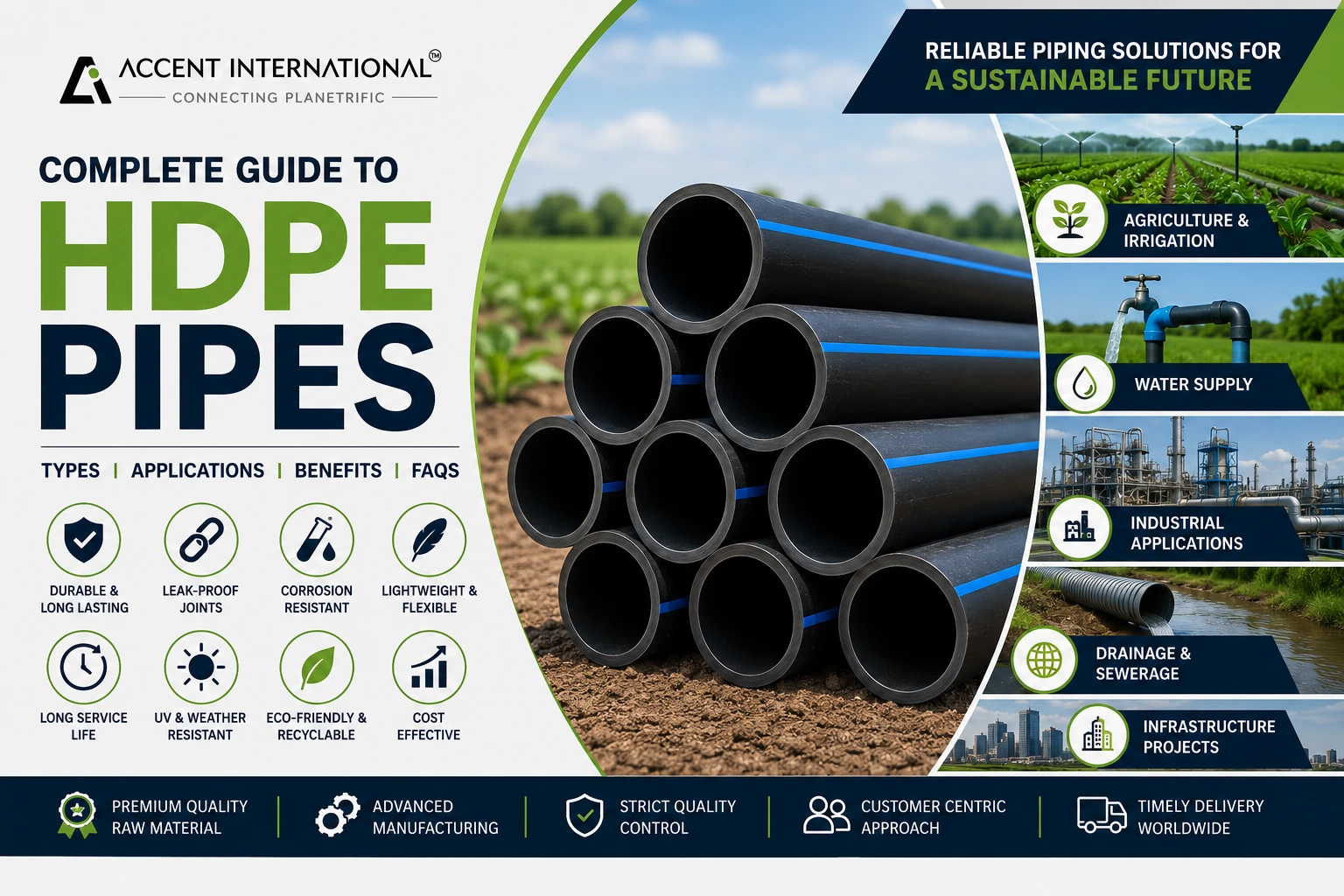
What is an HDPE Pipes?
HDPE stands for High-Density Polyethylene, a thermoplastic polymer made from petroleum. HDPE pipes are manufactured using high-density polyethylene resin, which provides outstanding durability, flexibility, and resistance to chemicals and environmental conditions.
Unlike traditional metal or concrete pipes, HDPE pipes do not rust, corrode, or crack easily. They are lightweight, easy to install, and capable of handling high-pressure applications while maintaining excellent flow efficiency.
Key Features-
- High strength-to-density ratio
- Corrosion and chemical resistance
- Leak-proof fusion-welded joints
- Lightweight and easy installation
- UV and weather resistance
- Smooth internal surface for better flow
- Long service life of over 50 years
- Low maintenance requirements
- Environmentally friendly and recyclable
Types of HDPE Pipes –
HDPE pipes are available in different grades and designs to suit various applications.
- PE80 HDPE Pipes
PE80 pipes offer excellent strength and flexibility for medium-pressure applications.
Applications:
- Agricultural irrigation
- Water distribution systems
- Rural water supply projects
- PE100 HDPE Pipes
PE100 pipes are the most widely used HDPE pipes due to their superior pressure resistance and durability.
Applications:
- Municipal water supply
- Industrial piping systems
- High-pressure irrigation networks
- Underground water transportation
- HDPE Irrigation Pipes
These pipes are specifically designed for efficient water delivery in agriculture.
Applications:
- Drip irrigation Sprinkler Irrigation Systemsystems
- Sprinkler irrigation systems
- Farm water management
Manufactured for potable and non-potable water transportation.
Applications:
- Drinking water distribution
- Urban and rural water supply schemes
- Residential and commercial projects
- Corrugated HDPE Pipes
Featuring a ribbed outer structure and smooth inner wall, these pipes are ideal for drainage systems.
Applications:
- Stormwater drainage
- Highway drainage
- Underground infrastructure projects
- HDPE Duct Pipes
Designed to protect electrical and telecommunication cables.
Applications:
- Optical fiber cable installations
- Telecom infrastructure
- Power cable protection
- HDPE Industrial Pipes
Built to withstand demanding industrial environments.
Applications:
- Chemical transportation
- Process water systems
- Mining operations
- Industrial effluent management
Applications of HDPE Pipes
HDPE pipes are used across numerous industries because of their versatility and performance.
Agriculture and Irrigation
Agriculture is one of the largest users of HDPE pipes. Their flexibility and leak-free joints help maximize water efficiency and improve crop productivity.
Common uses include:
- Drip irrigation systems
- Sprinkler irrigation systems
- Greenhouse irrigation
- Horticulture and orchard farming
- Borewell water distribution
Water Supply Systems
HDPE pipes are widely used in water distribution networks because they ensure safe and reliable water transportation.
Applications include:
- Municipal water supply
- Drinking water distribution
- Rural water infrastructure
- Water treatment plants
Industrial Applications
Industries rely on HDPE pipes for transporting liquids, chemicals, and wastewater.
Common industrial applications:
- Chemical processing plants
- Food and beverage industries
- Pharmaceutical facilities
- Manufacturing units
- Mining operations
Drainage and Sewerage Systems
HDPE pipes are ideal for wastewater management because they resist abrasion and corrosion.
Applications include:
- Sewerage systems
- Stormwater drainage
- Wastewater treatment plants
- Underground drainage networks
Infrastructure Projects
Modern infrastructure projects use HDPE pipes extensively for underground utilities and water management systems.
Applications include:
- Smart city developments
- Road and highway drainage
- Underground utility corridors
- Construction projects
Benefits of HDPE Pipes
Exceptional Durability
HDPE pipes resist cracking, corrosion, and environmental stress, making them suitable for challenging conditions.
Leak-Free Performance
Fusion welding technology creates seamless joints that eliminate leakage and reduce water loss.
Long Service Life
With proper installation, HDPE pipes can provide reliable performance for more than 50 years.
Cost-Effective Solution
Lower installation and maintenance costs help reduce overall project expenses.
Chemical and Corrosion Resistance
HDPE pipes perform exceptionally well when transporting chemicals, wastewater, and industrial fluids.
High Flexibility
Their flexibility allows them to absorb ground movement and pressure fluctuations without damage.
FAQS - HDPE Pipe?
What does HDPE stand for?
HDPE pipes are used for irrigation, water supply, drainage, sewerage, industrial fluid transportation, cable protection, and infrastructure projects.
What are HDPE pipes used for?
HDPE stands for High-Density Polyethylene, a durable thermoplastic material used for manufacturing high-performance piping systems.
Which HDPE pipe grade is best?
PE100 HDPE pipes are considered the best option for high-pressure and long-term applications due to their superior strength and performance.
Are HDPE pipes suitable for drinking water?
Yes. HDPE pipes are widely used for potable water distribution because they are safe, non-toxic, and resistant to contamination.
How long do HDPE pipes last?
HDPE pipes can last more than 50 years under normal operating conditions and proper installation practices.
Are HDPE pipes suitable for irrigation?
Absolutely. HDPE pipes are one of the most popular choices for drip irrigation, sprinkler irrigation, and agricultural water distribution systems.
Can HDPE pipes be installed underground?
Yes. Their flexibility, corrosion resistance, and durability make HDPE pipes ideal for underground installations.