

Drip Irrigation for Sugarcane: Complete Guide to Water Saving, Fertigation, Cost & System Design
Sugarcane is a high-water-demand, long-duration crop. For farmers, the challenge is not simply providing enough water—it is providing the right amount of water at the right time while keeping irrigation, fertilizer and labour costs under control.
This is where drip irrigation for sugarcane can make a major difference.
Unlike flood or furrow irrigation, which distributes water across a large area, a properly designed drip irrigation system delivers water gradually and more precisely around the crop root zone. It can also be used for fertigation, allowing soluble fertilizers to be applied through the irrigation system.
Research and field studies have reported improvements in water-use efficiency, yield and fertilizer-use efficiency when drip irrigation and fertigation are properly designed and managed. However, results depend on soil type, climate, variety, planting method, system design and farm management.
In this guide, we explain how drip irrigation works for sugarcane, how to select the right system, emitter spacing, irrigation scheduling, fertigation, maintenance, cost considerations and common mistakes to avoid.
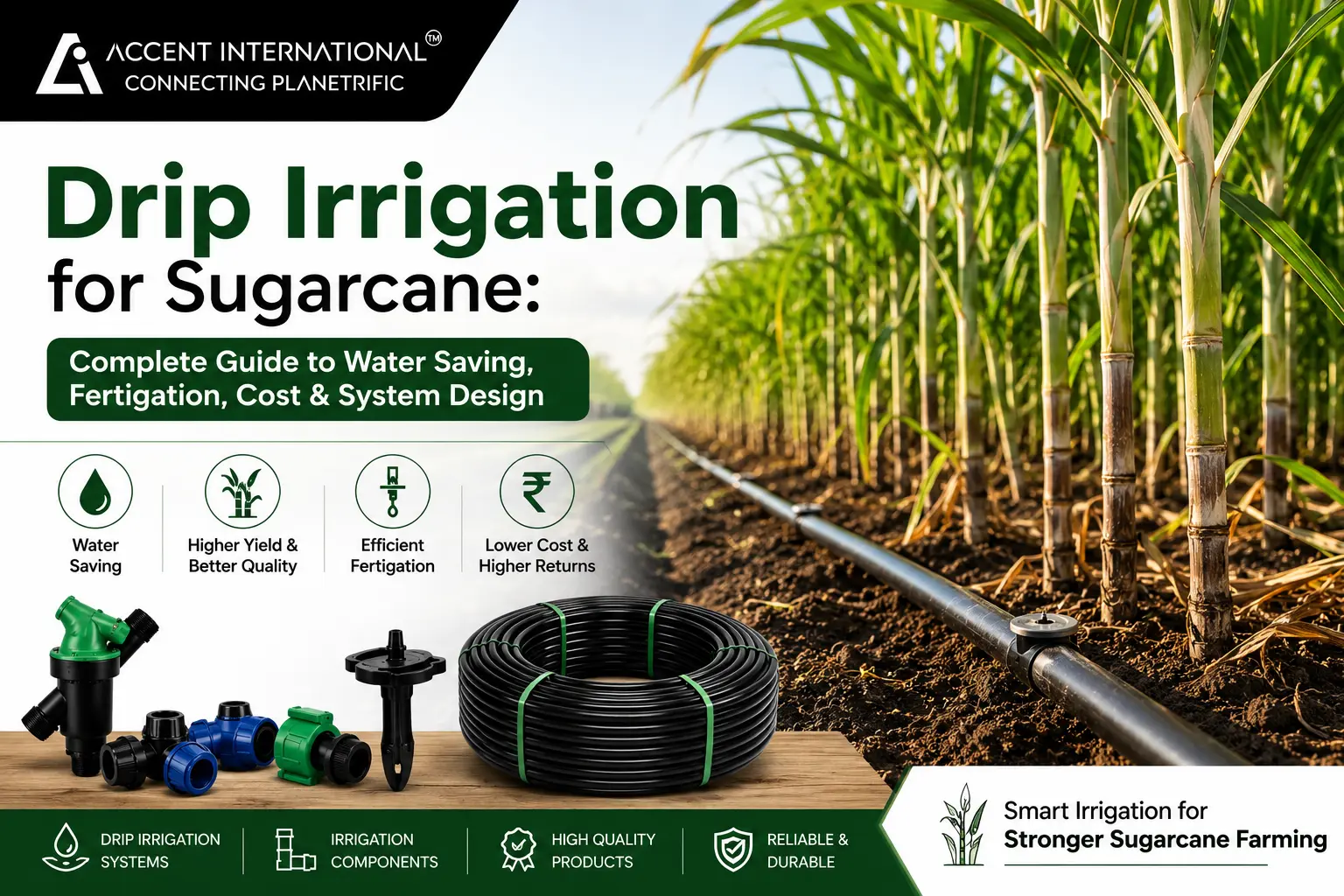
What Is Drip Irrigation for Sugarcane?
Drip irrigation is a micro-irrigation method in which water is delivered through pipes and drip laterals fitted with emitters.
For sugarcane, the system normally consists of:
- Water source
- Pumping system
- Mainline
- Sub-main lines
- Drip laterals
- Emitters or drippers
- Filters
- Valves
- Pressure regulators
- Fertilizer injection or fertigation equipment
- Connectors and other fittings
The objective is simple: deliver water and nutrients efficiently to the crop while reducing unnecessary water losses.
Sugarcane is particularly suitable for drip irrigation because it remains in the field for a long period and has a substantial water requirement throughout its growth cycle.
Why Is Drip Irrigation Important for Sugarcane?
Traditional flood and furrow irrigation can result in uneven water distribution, runoff, evaporation and deep percolation, depending on field conditions.
Drip irrigation allows irrigation to be managed more precisely.
The main advantages include:
Better Water-Use Efficiency
Sugarcane requires substantial quantities of water. A drip system can apply water closer to the active root zone and reduce losses associated with conventional surface irrigation.
TNAU reports water savings of around 40–70% under suitable drip irrigation management, while published reviews have reported water savings of approximately 20–60% compared with conventional irrigation. Actual savings vary according to soil, climate, irrigation practice and system design.
More Uniform Irrigation
A properly designed drip system can provide relatively uniform water distribution throughout the field.
This is important because uneven irrigation can result in:
- Poor crop growth
- Uneven tillering
- Water stress in some areas
- Excess water in other areas
- Uneven cane development
Fertigation Becomes Easier
One of the biggest advantages of drip irrigation in sugarcane is the ability to combine irrigation and fertilizer application.
This is known as fertigation.
Instead of applying all fertilizer at once, nutrients can be supplied in smaller doses according to crop requirements.
Research from western Maharashtra found that drip fertigation improved nutrient-use efficiency and, under the tested conditions, produced substantially higher cane yield than the conventional method. Results from individual experiments should not be treated as guaranteed farm-level increases, but they demonstrate the potential of properly managed drip fertigation.
Reduced Labour Requirement
Traditional irrigation may require considerable labour for moving water, opening and closing field channels and managing irrigation operations.
A properly designed drip system can reduce much of this work.
Better Control Over Crop Watering
Instead of waiting for the soil to become excessively dry and then applying a large quantity of water, farmers can irrigate more frequently with controlled quantities.
The exact irrigation schedule should be based on crop stage, weather, soil type, rainfall and available irrigation water.
Better Integration With Modern Sugarcane Farming
Drip irrigation can work particularly well with practices such as:
- Paired-row planting
- Fertigation
- Mulching
- Improved planting material
- Soil-moisture monitoring
- Automated irrigation
- Ratoon crop management
How Does a Drip Irrigation System for Sugarcane Work?
A typical system follows this path:
Water Source → Pump → Filter → Mainline → Sub-main → Laterals → Emitters → Sugarcane Root Zone
The filtration stage is extremely important.
Small particles, algae, sand and other contaminants can clog emitters. Therefore, the filter should be selected according to the quality of the irrigation water and the type of drip system being installed.
A good system should also include appropriate valves, pressure management and flushing arrangements.
Drip Irrigation Layout for Sugarcane
There is no single drip layout that is correct for every sugarcane field.
The design depends on:
- Row spacing
- Planting method
- Soil texture
- Water quality
- Field size
- Field slope
- Crop variety
- Emitter discharge
- Available pressure
- Irrigation water availability
- Whether surface or subsurface drip is being used
For example, TNAU’s sugarcane guidance includes different configurations for single-row and paired-row systems, with emitter spacing and discharge selected according to the layout and conditions.
This is why farmers should avoid selecting lateral spacing and emitter discharge simply because another farm is using the same configuration.
What Dripline Spacing Is Suitable for Sugarcane?
Dripline spacing is one of the most important design decisions.
Published technical guidance shows that sugarcane systems can use different lateral arrangements depending on planting pattern. For paired-row systems, examples include lateral spacing in the range of approximately 1.4–2.0 m, while emitter spacing can vary according to soil and system design.
For lighter soils, closer emitter spacing can help maintain a more continuous wetted zone. Heavier soils can sometimes accommodate wider spacing because water moves differently through the soil.
Therefore:
Do not choose emitter spacing first and then design the farm around it.
The irrigation layout should be designed from the complete combination of:
soil + crop spacing + water requirement + emitter discharge + pressure + field dimensions.
What Emitter Flow Rate Is Suitable for Sugarcane?
Emitter discharge is commonly expressed in litres per hour (LPH).
Technical guidance for sugarcane includes emitter discharge rates in approximately the 1–3 LPH range for various configurations.
However, the correct discharge should be selected based on the complete hydraulic and agronomic design.
A higher LPH does not automatically mean better irrigation.
The goal is to achieve:
- Adequate root-zone wetting
- Good distribution uniformity
- Controlled application
- No excessive runoff
- Appropriate irrigation duration
Surface Drip vs Subsurface Drip for Sugarcane
Both systems can be used in sugarcane.
Surface Drip Irrigation
In surface drip, the laterals remain on or close to the soil surface.
Advantages:
- Easier inspection
- Easier maintenance
- Easier flushing
- Easier repair
- Lower complexity during installation
Subsurface Drip Irrigation
In subsurface drip irrigation, laterals are installed below the soil surface.
Advantages can include:
- Reduced interference with some farm operations
- Reduced exposure of laterals to physical damage
- Potentially efficient root-zone water delivery
- Suitability for certain long-term cropping systems
Recent research in Karnataka has also examined surface and subsurface drip irrigation for sugarcane under saline and mildly waterlogged conditions, showing that system choice and irrigation level can materially affect yield and water productivity.
Subsurface systems, however, require careful design, installation and maintenance.
How Often Should Sugarcane Be Irrigated Through Drip?
There is no universal answer such as “irrigate every two days” that works for every sugarcane field.
Irrigation frequency should consider:
- Crop growth stage
- Temperature
- Evapotranspiration
- Soil type
- Rainfall
- Root-zone moisture
- Irrigation system capacity
- Water availability
TNAU guidance, for example, describes drip irrigation schedules based on crop evapotranspiration and notes irrigation at frequent intervals under suitable conditions.
The better approach is to determine how much water the crop needs and how quickly the soil is losing available moisture, rather than following a fixed calendar schedule.
Drip Irrigation and Fertigation in Sugarcane
Fertigation is one of the strongest reasons to consider drip irrigation for sugarcane.
Sugarcane has a long growth period and requires nutrients throughout its development.
With fertigation, nutrients can be supplied through the irrigation network in smaller, more frequent applications.
This can help improve nutrient availability near the active root zone and reduce the risk of applying more fertilizer than the crop can effectively use at one time.
TNAU recommends split application of nitrogen and potassium through fertigation in sugarcane, while recent industry guidance also emphasizes the role of drip fertigation in improving fertilizer-use efficiency.
However, fertilizer selection and fertigation schedules should be based on soil testing, crop requirements, water quality and local agronomic recommendations.
How Much Water Can Drip Irrigation Save in Sugarcane?
This is one of the most common questions farmers ask.
There is no single guaranteed percentage because water savings depend on the existing irrigation method and how efficiently the new system is operated.
Published Indian technical and review sources report substantial potential water savings from drip irrigation in sugarcane. TNAU reports 40–70% under suitable management, while a review of sugarcane drip irrigation reported 20–60% savings compared with conventional irrigation.
The important point is that installing drip irrigation alone does not guarantee maximum water saving.
The system must also be:
- Correctly designed
- Properly pressurized
- Regularly flushed
- Properly filtered
- Scheduled according to crop demand
- Maintained throughout the season
Is Drip Irrigation Worth It for Sugarcane?
For farms where irrigation water, pumping energy or labour is a significant cost, drip irrigation can be worth considering.
The economics should be evaluated using:
Initial system cost + operating cost + maintenance cost
against:
Water savings + energy savings + labour savings + potential yield improvement + fertilizer-use efficiency
The payback period will vary by farm.
A farmer should calculate the economics using actual:
- Acreage
- Water source
- Pump capacity
- Electricity/diesel cost
- Current irrigation method
- Sugarcane yield
- Fertilizer expenditure
- Labour cost
- Expected drip system cost
Common Mistakes in Sugarcane Drip Irrigation
Even a good drip system can perform poorly if it is badly managed.
Mistake 1: Using an Undersized Filter
Poor filtration can lead to emitter clogging.
Mistake 2: Selecting Driplines Only on Price
The cheapest lateral is not necessarily the most economical option over the complete crop cycle.
Mistake 3: Incorrect Pressure
Too little pressure can cause poor distribution. Excessive pressure can also damage components or affect system performance.
Mistake 4: Ignoring Flushing
Drip laterals should be flushed according to the system design and water quality.
Mistake 5: Using the Same Irrigation Schedule Throughout the Crop
Sugarcane water requirements change as the crop develops.
Mistake 6: Applying Fertilizer Without Considering Water Quality
Fertigation requires compatible fertilizers and proper management to reduce precipitation and clogging risks.
Mistake 7: Designing the System Without Considering Farm Machinery
Laterals and manifolds should be positioned with field operations in mind.
Mistake 8: No Regular System Inspection
Farmers should periodically check:
- Filter condition
- Pressure
- End-of-line discharge
- Leaks
- Blocked emitters
- Valve operation
- Fertigation equipment
How to Maintain a Sugarcane Drip Irrigation System
A simple maintenance routine can significantly improve system performance.
Before Irrigation
Check:
- Pump
- Filter
- Pressure
- Valves
- Mainline
- Visible leaks
During Irrigation
Check:
- Pressure at important points
- Uniform water delivery
- Leaks
- Blocked emitters
- Fertigation operation
Periodically
Carry out:
- Filter cleaning
- Lateral flushing
- End-line flushing
- Emitter inspection
- Fertigation system cleaning
- Pressure checks
The frequency depends heavily on irrigation-water quality.
Drip Irrigation for Sugarcane: Best Practices
For better performance, consider these practices:
- Test irrigation water before designing the system.
- Select filtration according to water quality.
- Design laterals according to field dimensions and crop spacing.
- Choose emitter spacing based on soil and root-zone wetting.
- Maintain appropriate operating pressure.
- Use fertigation according to crop and soil requirements.
- Monitor soil moisture and crop condition.
- Adjust irrigation according to weather and crop stage.
- Flush the system regularly.
- Inspect the system before problems become visible across the field.
Frequently Asked Questions-FAQs
Is drip irrigation good for sugarcane?
Yes. Sugarcane is well suited to drip irrigation because it is a long-duration crop with significant water requirements. Properly designed drip systems can improve water-use efficiency and support fertigation.
How much water can drip irrigation save in sugarcane?
Published sources report potential savings ranging broadly from around 20% to 70%, depending on the comparison method, system design, climate, soil and management. Farmers should treat these as potential ranges rather than guaranteed results.
What is the best dripline spacing for sugarcane?
There is no universal spacing. The correct spacing depends on planting pattern, soil type, emitter characteristics and system design. Technical guidance includes different arrangements for single-row and paired-row sugarcane.
Can fertilizer be applied through sugarcane drip irrigation?
Yes. This process is called fertigation. Water-soluble fertilizers can be delivered through the drip system when the irrigation and fertigation system is correctly designed and operated.
Is surface or subsurface drip better for sugarcane?
Both can work. Surface drip is generally easier to inspect and maintain, while subsurface drip can offer advantages for certain long-term production systems. The choice depends on farm operations, soil, economics and management capability.
How much does sugarcane drip irrigation cost per acre?
There is no fixed price. Current market estimates can vary substantially based on system design and automation. A 2026 Maharashtra industry estimate puts a standard system around ₹45,000–₹60,000 per acre, but farmers should obtain a site-specific quotation.
Does drip irrigation increase sugarcane yield?
Research has found yield improvements under various drip irrigation and fertigation treatments, but the result is not guaranteed. Yield depends on variety, soil, planting method, water management, fertilizer management, climate and overall crop practices.