

uPVC vs CPVC Pipes: What Is the Difference and Which One Should You Choose?
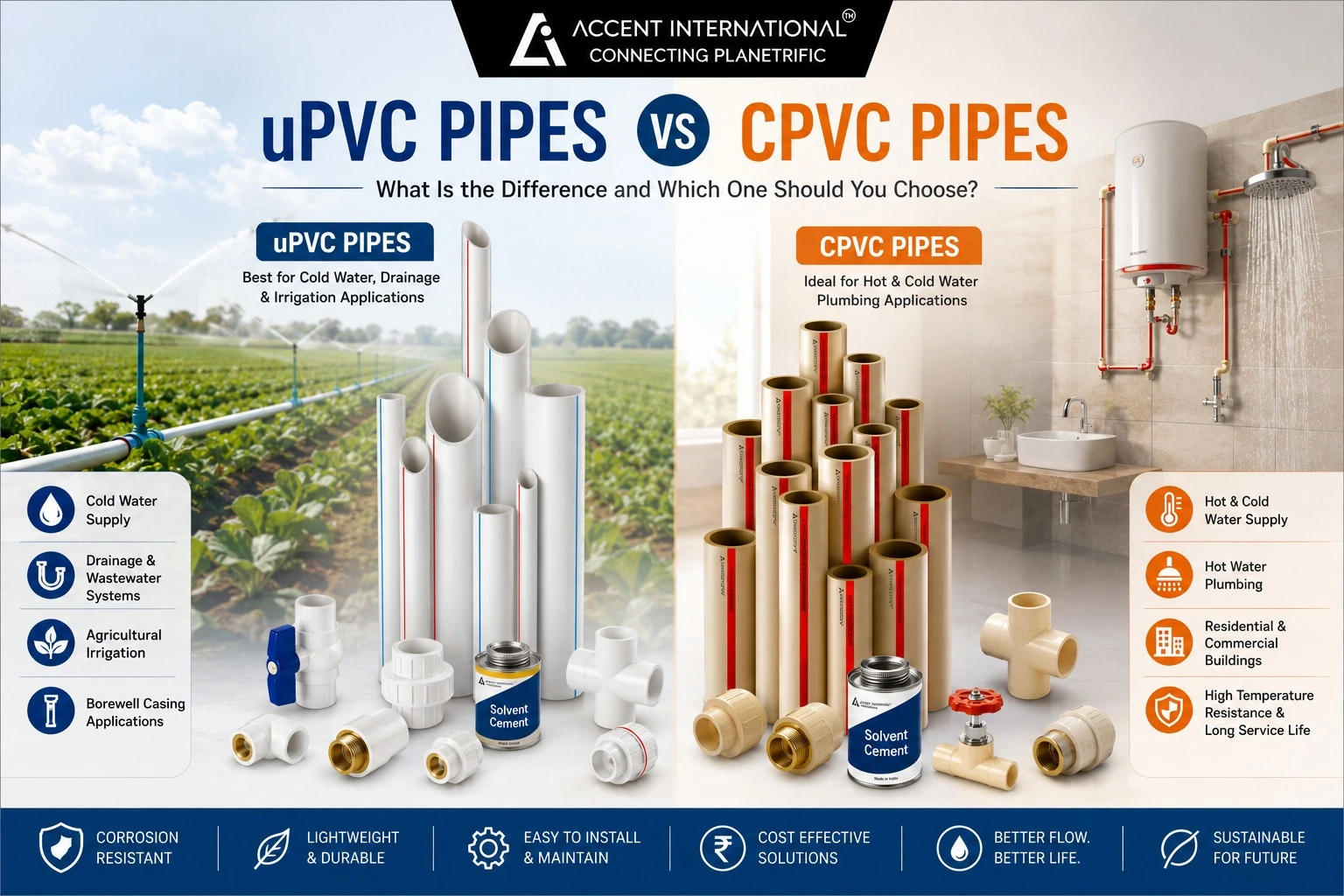
uPVC is generally associated with cold-water and infrastructure applications, while CPVC is particularly useful when hot water is involved.
When you are looking for a pipe for a water supply, plumbing, irrigation or construction project, you will often come across two familiar names: uPVC and CPVC.
At first glance, they can look quite similar. Both are plastic pipes, both are lightweight, both resist corrosion and both are widely used for water applications.
But they are not made for exactly the same job.
The most important difference between uPVC and CPVC is their ability to handle temperature. uPVC is commonly used for cold-water, drainage, irrigation and other applications where high temperatures are not involved. CPVC, on the other hand, is designed to handle higher temperatures and is therefore widely used for hot-water plumbing.
So, which one should you buy?
That depends on where and how you plan to use the pipe.
Let’s look at the difference in simple terms.
What Is uPVC Pipe?
uPVC stands for Unplasticized Polyvinyl Chloride.
The word “unplasticized” simply means that plasticizers are not added to make the material flexible. As a result, uPVC is a rigid material that can be manufactured into strong and durable pipes.
You will find uPVC pipes in many water and infrastructure applications, particularly where the system carries water at normal temperatures.
Common applications include:
- Agricultural irrigation
- Cold-water supply
- Drainage systems
- Underground water pipelines
- Borewell casing applications
- Rainwater and wastewater systems
- Industrial water distribution
One of the reasons uPVC is popular is that it offers a good balance between performance, durability and cost.
It is also resistant to rust and corrosion, which is a major advantage compared with traditional metal piping in many applications.
What Is CPVC Pipe?
CPVC means Chlorinated Polyvinyl Chloride.
CPVC starts with PVC resin, but the material undergoes an additional chlorination process. This changes some of its properties and gives it a much higher temperature capability than standard uPVC.
This is why CPVC is commonly found in household and commercial plumbing systems where both hot and cold water need to be carried.
Typical applications include:
- Hot-water plumbing
- Geyser connections
- Solar water-heating systems
- Residential plumbing
- Hotels and commercial buildings
- Hospitals and institutional buildings
- Cold-water plumbing where CPVC is specified
uPVC vs CPVC: The Difference in Simple Terms
Imagine two different situations.
You are installing a pipeline to carry water from a farm pump to an irrigation system.
There is normally no need for the pipe to handle high-temperature water. In this situation, a suitable uPVC or other irrigation-rated pipe may be a practical choice.
Now imagine you are installing a pipeline from a geyser to a bathroom.
The water can become quite hot, so the pipe needs to be designed for elevated temperatures. This is where CPVC becomes a much more suitable option.
The choice is therefore less about which material is “better” and more about which material is right for the job.
uPVC vs CPVC Pipes: Main Differences
| Factor | uPVC | CPVC |
| Full form | Unplasticized Polyvinyl Chloride | Chlorinated Polyvinyl Chloride |
| Main advantage | Rigid, durable and economical for many applications | Better performance at elevated temperatures |
| Cold water | Suitable for appropriate applications | Suitable for appropriate applications |
| Hot water | Generally not suitable | Designed for hot-water applications |
| Irrigation | Commonly used | Usually not necessary for standard irrigation |
| Drainage | Commonly used | Generally not the first choice |
| Borewell applications | Specialized uPVC products are widely used | Not normally used for borewell casing |
| Corrosion resistance | Good | Good |
| Weight | Lightweight | Lightweight |
| Cost | Generally lower | Generally higher |
| Typical plumbing use | Cold-water, drainage and related systems | Hot- and cold-water plumbing |
The exact performance of any pipe depends on its grade, dimensions, pressure class, applicable standard and manufacturer’s specifications.
Why Is CPVC Better for Hot Water?
This is probably the most important question when comparing uPVC and CPVC.
The additional chlorination used in CPVC changes the material’s thermal performance.
As a result, CPVC is able to handle temperatures that ordinary uPVC plumbing products are not designed to handle.
This makes CPVC useful for systems connected to:
- Geysers
- Water heaters
- Solar water heaters
- Hot-water storage systems
- Hot-water distribution lines
The actual maximum working temperature should always be checked from the manufacturer’s technical data. Different products and standards can have different ratings.
So if your project involves hot water, don’t choose a pipe simply because it looks similar to another PVC pipe. Check the temperature rating first.
uPVC vs CPVC for Plumbing
Plumbing is where the difference becomes more important.
For a cold-water line, a suitable uPVC or CPVC system may be considered depending on the project specification.
For hot water, CPVC is generally the more appropriate choice because it is specifically designed for elevated temperatures.
A simple way to remember it is:
Cold water → uPVC can be suitable
Hot water → CPVC is generally the better choice
But always check the manufacturer’s specifications before installation.
Which Is Cheaper: uPVC or CPVC?
In many markets, uPVC is generally less expensive than CPVC.
The reason is straightforward: CPVC is a more specialized material designed to provide higher temperature performance.
But price should not be the only factor.
Suppose you are installing a hot-water system and choose a cheaper pipe that isn’t designed for that temperature.
The initial saving could easily disappear if the system develops problems and needs repairs or replacement.
On the other hand, using a higher-cost CPVC system for an application that does not need its temperature capability may unnecessarily increase the project cost.
The smarter approach is to look at the total cost of the system, not simply the price of one pipe.
What About Pipe Strength?
People often ask:
“Which is stronger, uPVC or CPVC?”
The answer depends on what you mean by strength.
A pipe can have excellent mechanical strength but still be unsuitable for a particular temperature.
Similarly, pressure performance depends on pipe dimensions, temperature, material formulation, standard and pressure class.
Therefore, comparing the two materials using a single “strength” number can be misleading.
Instead, check the manufacturer’s specifications for:
- Working pressure
- Temperature rating
- Dimensions
- Wall thickness
- Applicable standard
- Intended application
That gives you a much more useful comparison.
Common Mistakes People Make When Choosing uPVC or CPVC
Choosing Only on Price
A low price does not necessarily mean a better product.
Always check what application the pipe is designed for.
Using Standard uPVC for Hot Water
This is one of the mistakes that should be avoided.
If the system carries hot water, use a product specifically rated for that service.
Assuming All PVC Pipes Are the Same
They aren’t.
uPVC plumbing pipes, CPVC pipes, SWR pipes, borewell casing pipes and irrigation pipes can have very different specifications.
Ignoring Pressure
A pipe must be suitable for the actual pressure in the system.
This becomes especially important in pumping and irrigation applications.
Mixing Different Systems Without Checking Compatibility
Use compatible pipes, fittings, solvent cement and accessories as recommended by the manufacturer.
Choosing the Pipe Before Understanding the Application
This is perhaps the biggest mistake.
First understand what the system needs to do.
Then select the pipe.
So, Which One Should You Choose?
Here’s the practical answer.
Choose uPVC if you need a pipe for:
- Agricultural irrigation
- Cold-water distribution
- Drainage
- Suitable underground water lines
- Borewell casing applications using purpose-designed products
- Other applications where the product’s temperature and pressure ratings are appropriate
Choose CPVC if you need a pipe for:
- Hot-water plumbing
- Geyser connections
- Solar water-heating systems
- Hot and cold residential plumbing
- Commercial hot-water systems
- Other applications where elevated-temperature service is required
uPVC vs CPVC: The Bottom Line
There isn’t really a winner between uPVC and CPVC.
They solve different problems.
uPVC is a practical choice for many cold-water, irrigation, drainage and borewell-related applications.
CPVC is particularly useful where the piping system needs to carry hot water.
So before buying a pipe, ask yourself three simple questions:
What will the pipe carry?
What temperature will it operate at?
What pressure will the system generate?
Once you know those three things, choosing between uPVC and CPVC becomes much easier.
For irrigation, borewell and agricultural water-management projects, the pipe should be selected according to the actual field conditions and system requirements rather than simply choosing the most popular or cheapest option.
Accent International supplies piping and water-management solutions for agricultural, irrigation and borewell applications. If you are unsure which pipe or piping solution is suitable for your project, discuss the application and operating requirements with your supplier before placing the order.
Frequently Asked Questions-FAQs
Is uPVC better than CPVC?
Neither is universally better. uPVC is generally suitable for cold-water, drainage, irrigation and related applications, while CPVC is designed to handle higher temperatures and is commonly used for hot-water plumbing.
Can uPVC be used for hot water?
Standard uPVC products are generally not intended for hot-water service. Always follow the temperature rating and application recommendations of the specific manufacturer.
Can CPVC be used for cold water?
Yes. CPVC can be used for cold-water applications when the specific product is designed and approved for that purpose.
Which is better for agricultural irrigation, uPVC or CPVC?
For normal agricultural irrigation, a suitable uPVC irrigation or pressure pipe is often the more practical choice. CPVC’s higher temperature capability is generally not needed for ordinary irrigation.
Which is cheaper, uPVC or CPVC?
uPVC is generally more economical, although actual prices depend on size, pressure class, specifications, brand and market conditions.
Which pipe should be used for a geyser?
CPVC is commonly used for hot-water connections from geysers and water heaters, provided the selected product is rated for the required temperature and pressure.
Can uPVC and CPVC fittings be mixed?
They should not be mixed automatically. Always follow the pipe manufacturer’s recommendations regarding fittings, solvent cement and joining methods.
Is CPVC stronger than uPVC?
It is better to compare the specific pipe’s pressure and temperature ratings rather than simply calling one material stronger. Both materials have different properties and are designed for different applications.
Final Takeaway
uPVC and CPVC may look similar, but they have different jobs.
If your project involves cold water, irrigation, drainage or a suitable borewell application, uPVC can be an effective and economical option.
If your project involves hot water, CPVC is generally the more suitable choice because it is designed for higher operating temperatures.
The best pipe is not necessarily the strongest, thickest or cheapest one.
It is the one that is correctly specified for the job.